Creator Corner: Author Karen Krossing and Illustrator Julia Vasileva
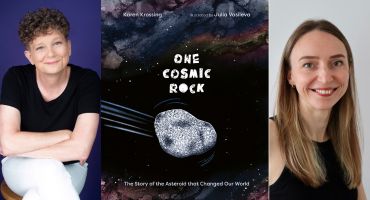
Welcome to Creator Corner, a blog series where we interview the creators of our recent and upcoming books. For this post, we interviewed One Cosmic Rock author Karen Krossing and illustrator Julia Vasileva, whose book published February 17, 2026!
Owlkids Books: Karen, what inspired you to write this book?
Karen Krossing: I was inspired by a quote by Ludovic Ferrière, curator of the rock collection at Vienna’s Natural History Museum, who said, “Rocks are like books. You can look at the cover and get some basic information, but it’s when you open them that you get the full story.” My first draft was about a meteor crashing into Earth, and yet the wonderful editorial staff at Owlkids Books suggested I might focus instead on the asteroid that impacted the dinosaurs 66 million years ago. I dove into research and was immediately hooked. Such drama! Huge stakes! Because of the asteroid’s size, speed, and how it hit the planet, it caused terrific damage. Life suffered, and most large species went extinct. Yet some small species found ways to survive and later thrive.
Owlkids Books: Julia, what was the inspiration for your illustrations in this book?
Julia Vasileva: All the prehistoric creatures in this book survived only in fossils or natural history paintings, so researching and studying those was quite inspiring for me.
OKB: Karen, what was the most enjoyable part of bringing this story to life? What was the most challenging part of the process?
KK: I loved writing this dramatic, life-and-death story. It let me use punchy verbs and play with rhythm and sound. This book is a powerful read-aloud. Still, it was a challenge to figure out how to write about the mass extinction of many species in a way that honors the truth yet remains sensitive to the child reader. After much thought, I placed the extinction at the midpoint so my story would focus on resilience and adaptation after an unimaginable setback. I also included information in the backmatter about how scientists work to protect the Earth from another impact event, further caring for the anxious reader.
OKB: Julia, what was the most enjoyable part of illustrating this book? What was the most challenging part?
JV: I love nature, so immersing myself in drawing the natural world was a gift. I remember that when I received the manuscript with art notes, I was a bit intimidated by the sheer number of life forms I’d need to draw. It ended up being so fun—Karen’s research and detailed art notes were incredibly helpful, and I learned a lot along the way.
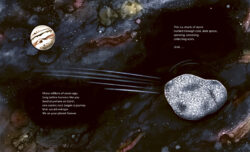
An unexpected creative challenge for me was painting space. My first attempts were too vibrant and colorful, inspired by those breathtaking, glowing NASA images we’ve all seen, until I was reminded of the actual blackness of space. It became an interesting process of finding the right balance between the book’s dramatic, inspiring introduction and the limitations of human vision. I also used a new technique for those cosmic spreads and learned how to work with alcohol inks the hard way (one should wear a respirator!).
OKB: Karen and Julia, what do you hope readers will take away from this book?
KK: I hope this book connects readers to their evolutionary past and the community of life on our planet. I hope they see it as a celebration of resilience. I hope they’re inspired by the many fascinating species that have inhabited this rock called Earth—from massive dinosaurs to tiny spiders with tails. I hope it brings them hope.
JV: I hope they come out of it with a sense of awe—our existence is both a mere chance and a wonder. There was this catastrophic event of unimaginable scale, and yet life on our planet persevered. I think that’s quite awe-inspiring in itself. And I hope this book will be one tiny spark among a myriad of reasons why they move through the world with a sense of wonder.
OKB: Karen and Julia, what’s an interesting fact you learned while writing this book?
KK: Only one?! That’s tough. I learned that if this asteroid had never hit Earth, life would have evolved differently. This rare event allowed the survivors to flourish, including our long-ago ancestors. It makes me wonder: Is it possible that humans like us exist because of one cosmic rock?
JV: I find it fascinating that mainly small mammals survived the mass extinction, and that they were able to do so by sheltering underground. Some already lived in burrows, while others adapted to life below the surface. Imagine those small, furry land creatures who looked so tiny and vulnerable compared to the giants inhabiting the Earth back then!
OKB: Karen and Julia, what’s an interesting fact people may not know about you?
KK: When I was a kid, I entered the science fair at my school every year. I adored it. It all started because of a moldy orange in our fridge. I put it in a clear jar with a tight lid and watched the mold grow and change. I did the same with other foods. I’m endlessly fascinated by our world and the life-forms we share it with.
JV: I try to hide a cat in every book, even if it’s a book about an asteroid. And yes, there is a cat in One Cosmic Rock, go find it!
Thank you so much Karen and Julia for taking the time to do this interview and creating a wonderful book! We hope readers enjoy One Cosmic Rock as much as we did!
Grab your copy today!